
ANSWERS to frequently asked questions
What is NeurOptimal® neurofeedback?
NeurOptimal neurofeedback is a brain training method based on dynamical neurofeedback. It relies on the brain’s natural ability to adapt, learn and reorganise its functioning.
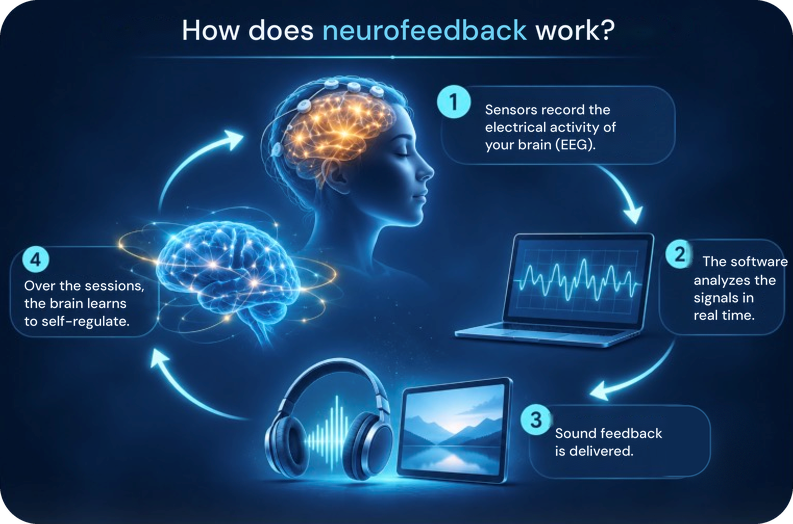
Thanks to small sensors placed on the scalp and ears, the system picks up the brain’s electrical activity (EEG) in real time. Specialised software then analyses this information and spots variations in brain activity. When a significant change appears, the music you are listening to is briefly interrupted. These micro-interruptions provide feedback “directed” at the nervous system about its own functioning.
The sensors only record brain activity: no electrical current is sent into the brain.
You have nothing to do, nothing to achieve and no particular effort to make. You can simply settle in comfortably and listen to your music or watch a film, while the system works in the background.
NeurOptimal® neurofeedback collects brain activity in real time and sends feedback through brief interruptions in the sound. As a result, the brain learns, its connections reorganise and its networks gradually become more adaptable.
How does NeurOptimal® promote neuroplasticity?
Our brain is a living, dynamic and extraordinarily adaptable system. At every moment, it processes a multitude of information coming from our environment, our perceptions, our bodily sensations and our emotions.
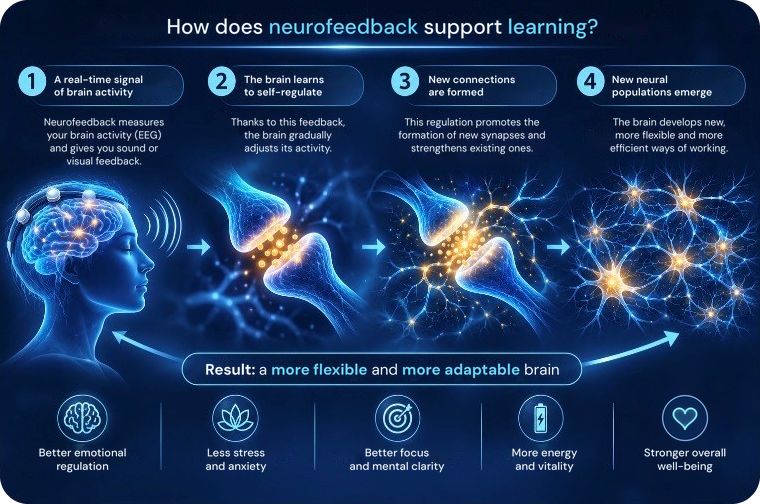
Thanks to the feedback provided by NeurOptimal®, the brain has an opportunity to perceive its own variations in activity and to adjust its functioning through its natural self-regulation mechanisms. This is where neuroplasticity comes in: this remarkable ability of the brain to modify its connections, reorganise its networks and develop new ways of functioning.
Over the course of the sessions, this training can therefore support greater brain flexibility and a better capacity to adapt. It is not about imposing an ideal way of functioning on the brain, but about offering it information so that it can mobilise its own adaptive resources.
In short, neuroplasticity allows the brain to gradually reorganise its networks and develop new ways of functioning.
What is the difference between dynamical and analytical neurofeedback?
There are two main approaches to neurofeedback, and they rely on distinct operating principles. Traditional neurofeedback, known as analytical or linear, generally uses positive feedback. Certain brain activities are targeted: the brain receives a reward when it produces the desired frequencies. It is thus trained to strengthen or reduce certain activities according to objectives defined in advance. This approach relies on protocols and generally requires a prior analysis to determine the parameters to work on. The brain is therefore guided towards a desired way of functioning from the outside.
NeurOptimal® Dynamical Neurofeedback® offers a radically different approach. It is based on negative feedback, a natural self-regulation mechanism of living systems. Its great strength lies in the speed and continuity of the information transmitted. The software analyses the brain’s electrical activity 256 times per second and detects its variations in real time. When a significant change is spotted, a very brief interruption of the music tells the nervous system what has just happened. As a result, it receives immediate information about its own activity, with no reward, no instruction and no target frequency. Rather than teaching it to function in a certain way, NeurOptimal® gives it constant feedback on its fluctuations. It therefore remains free to adapt at every moment.
That is the whole originality of NeurOptimal®: trusting the natural intelligence of the nervous system and its capacity for self-regulation. Repeated throughout the session, this feedback gives the brain many opportunities to mobilise its own adaptation mechanisms. The aim is not to correct or direct it, but to allow it to regain more flexibility. This non-directive approach requires no effort: you simply settle in comfortably, listen to the music and let the system do its work.
What if I feel nothing during a session?
That is a very common question!
With NeurOptimal®, you do not need to feel anything during the session for the training process to take place.
The micro-interruptions in the music are sometimes so subtle that they go completely unnoticed. The system does not depend on your conscious attention. You can be relaxed, daydream, close your eyes or even doze off.
Some people feel calmer from the very first sessions. Others, however, notice changes more gradually, sometimes in areas they did not expect.
Changes can also be so subtle that they are only recognised in hindsight: more restorative sleep, a better ability to cope with stress, faster emotional recovery, more availability or a general sense of wellbeing.
And sometimes, no particular change is noticeable. This does not mean you did the session badly, but it does not allow us to conclude that the brain has necessarily changed either. Everyone reacts differently.
The important thing is to stay attuned to your own progress, without trying to force a result or to meet particular expectations.
How many sessions, and how often?
How many sessions should I plan for?
Each brain is unique. Its way of responding to the training and its progress cannot be determined in advance.
It is therefore impossible to set a universal number of sessions to achieve a specific change. Some people notice changes relatively quickly, while others need more time.
The key is to observe your progress, to become aware of any changes and to adapt the support to your needs.
How often should I have sessions?
One to two sessions a week is often recommended. In reality, because sessions are costly, practitioners do not recommend scheduling them closer together.
In practice, however, sessions can be fairly close together. Everyone experiences things differently. Some prefer sessions close together (sometimes up to twice a day!), while others prefer to space out the first sessions. The frequency should take into account each person’s feelings and preferences.
Afterwards, the pace can be adjusted according to your experience, your needs and your progress.
When should I stop the sessions?
It is also up to you to decide when to stop.
Some people wish to continue training to consolidate their experience. Others feel they have reached their goals and prefer to take a break.
There is no single path that fits everyone.
What results can be observed?
The changes reported with NeurOptimal® vary and are specific to each person.
They may include, in particular:
- Emotional regulation and stress management.
- Sleep quality and recovery.
- Concentration and mental clarity.
- Self-confidence and inner availability.
- The ability to step back from events.
- Vitality and a general sense of wellbeing.
However, these changes are not systematic and are not guaranteed results.
The fundamental idea remains the same: to support the brain’s natural self-regulation abilities and allow it to develop more flexibility in the face of life’s demands and changes
Our brain keeps this wonderful ability to learn and evolve throughout our lives. In fact, it is never too late to offer it new possibilities.